How a Beddel Agent Would Have Prevented the 100k Filevine File Leak
Analyzing the "Zero Auth" vulnerability discovered by Alex Schapiro and demonstrating how a declarative, edge-safe approach would neutralize the attack.

Recently, security researcher Alex Schapiro published an alarming analysis on how he gained full access to over 100,000 confidential files from a law firm using Filevine (valued at over $1 billion).
The attack vector was frighteningly simple:
1. An API endpoint (`/recommend`) exposed without any authentication.
2. A JSON response that inadvertently returned a `boxToken` with full admin privileges.
There was no need for complex SQL Injection or social engineering. Just an empty `POST` request and the “back door” swung open.
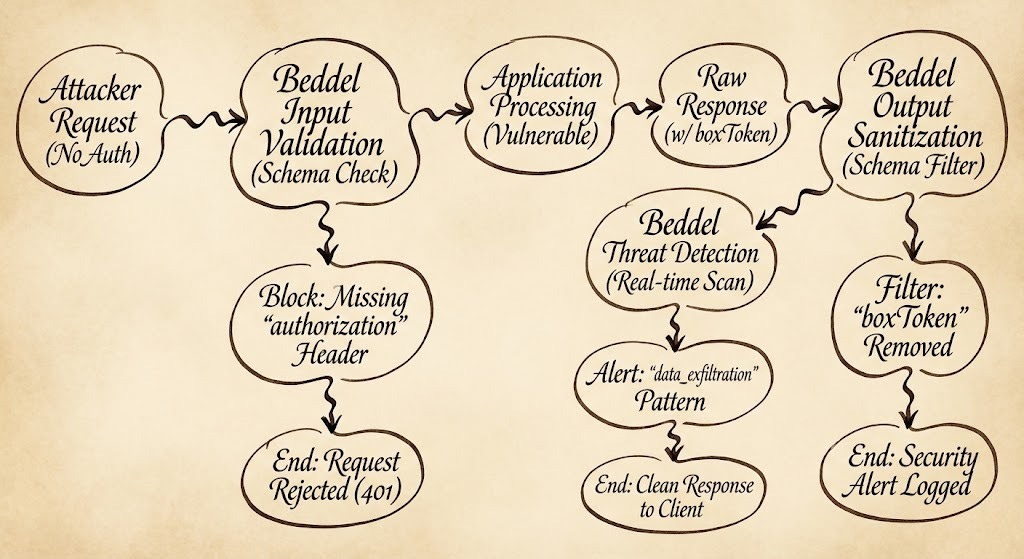
Today, I’ll show how the Beddel architecture, specifically an agent running as middleware (Edge-Safe), would have blocked this attack across three different layers using only native protocol resources.
The Beddel Philosophy: “Security by Schema”
In Beddel, security isn’t an “if” statement lost in the middle of controller code. Security is declarative. If it’s not in the contract (Schema), it doesn’t get in and it doesn’t get out.
To protect the Filevine API, we would deploy a middleware agent (`FilevineGuardian`) intercepting calls. Let’s look at the code.
The Protection Agent (`guardian.yaml`):
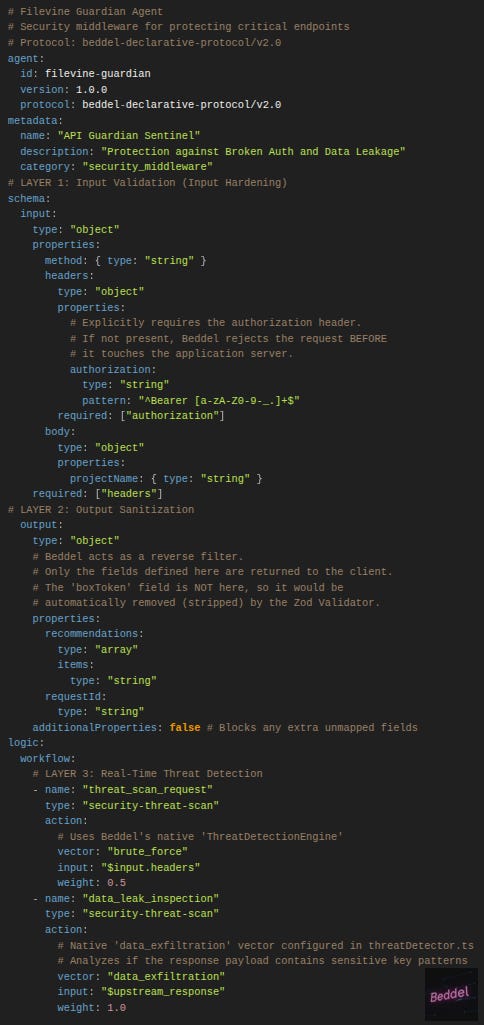
How would this have saved the day?
1. Blocking at Input (Broken Authentication)
In the original attack, Alex sent a request without tokens. With Beddel, the interpreter loads `schema.input`. Upon detecting the absence of the `headers.authorization` field (marked as `required`), the runtime triggers a `DeclarativeSchemaValidationError` immediately.
• Result: The attack stops here with a `400 Bad Request` or `401 Unauthorized`. The vulnerable Filevine server is never even triggered.
2. Blocking at Output (Data Leakage)
Let’s assume, hypothetically, that the attacker managed to bypass authentication (perhaps by stealing a valid session). The Filevine server would then process the request and return the fatal JSON containing the `boxToken`.
Here shines Beddel’s Output Schema. The interpreter takes the raw response from the server and validates it against `schema.output`.
• Does the `boxToken` field exist in the raw response? Yes.
• Does the `boxToken` field exist in `schema.output`? No.
• Is the `additionalProperties: false` setting active? Yes.
Beddel’s Action: The `boxToken` field is silently removed before being sent back to the client. The attacker would receive a clean JSON, without the administrative credentials.
3. Active Monitoring (Threat Intelligence)
Using the `security-threat-scan` resource (based on the `ThreatDetectionEngine` class we saw in the source code), the agent would be monitoring patterns. If the system detected a response containing high-entropy strings (like a JWT or Box Token) in an unauthorized field, the `data_exfiltration` vector would trigger a `CRITICAL` level alert, notifying the security team instantly via `AuditTrail`.
Conclusion
The Filevine case reminds us that relying solely on the application for protection is risky. Developers make mistakes, and debug endpoints are forgotten.
The Beddel protocol acts as an incorruptible bodyguard. It doesn’t know “how” the API works internally, it only knows the Contract. If the rule is “don’t leave without a badge” and “don’t take master keys outside,” Beddel guarantees this declaratively, protecting your infrastructure even when application code fails.
---
Link to original post: https://alexschapiro.com/security/vulnerability/2025/12/02/filevine-api-100k